How Is Female Infertility Diagnosed? Tests Your Gynaecologist May Recommend
Deciding to finally book a fertility consultation is often the hardest part. Once that appointment is on the calendar, a new kind of uncertainty tends to take over, what tests will actually happen, in what order, and how long before you get real answers.
If you have been noticing signs that made you consider a fertility evaluation, knowing what the diagnostic process actually looks like can make the entire experience feel far less overwhelming.
This guide walks through exactly how female infertility is diagnosed, test by test, in the order your gynaecologist is likely to recommend them.
When Does Infertility Testing Actually Begin?
Testing typically begins once a woman meets the clinical definition of infertility, generally a year of regular, unprotected intercourse without conceiving, or six months if she is 35 or older.
However, testing can reasonably begin earlier if there are known risk factors, such as very irregular or absent periods, a diagnosed condition like PCOS or endometriosis, a history of pelvic infection or surgery, or a partner with a known fertility issue.
There is no need to wait for a specific milestone if something already feels clearly off. Many gynaecologists would rather start an initial conversation and basic testing early than have a woman wait out a full year while something treatable goes unaddressed.
Your First Fertility Consultation: What to Expect
The diagnostic process almost always starts with a detailed conversation, not a test. Your gynaecologist will ask about your menstrual cycle, including length, regularity, and flow, your sexual history and how long you have been trying to conceive, any previous pregnancies or losses, your general medical history, including past surgeries, infections, or chronic conditions, and your family history, particularly around conditions like PCOS, endometriosis, or early menopause.
This conversation genuinely shapes everything that follows. Two women with the same complaint of “irregular periods” might end up on completely different testing paths depending on their specific history, which is exactly why this initial discussion matters as much as the tests themselves.
Female Infertility Tests: A Step-by-Step Breakdown
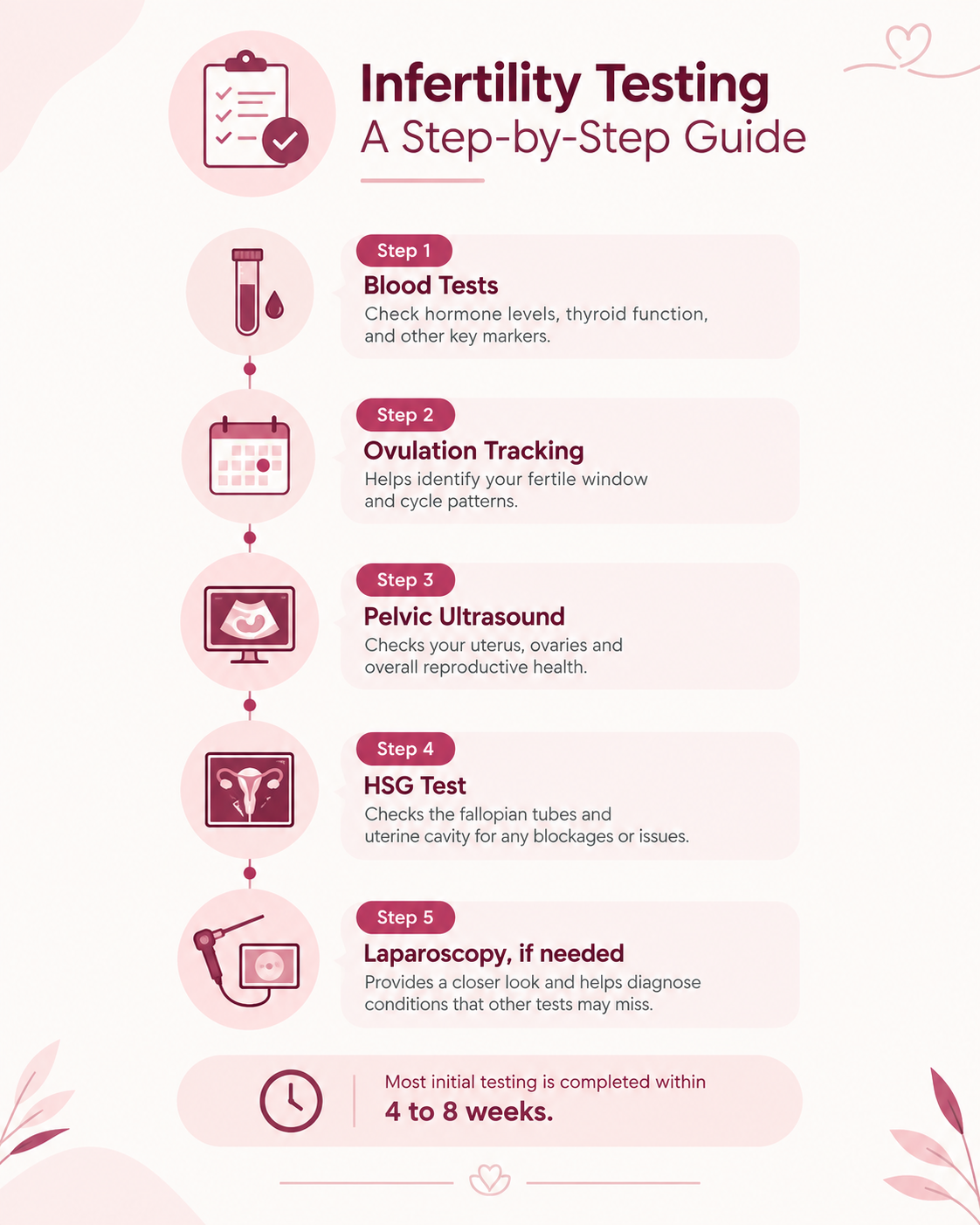
Fertility testing is usually done in stages, starting with the simplest, least invasive tests and only progressing to more involved testing if the initial results do not provide a clear answer. Here is the order most gynaecologists follow.
Step 1: Blood Tests to Check Hormone Levels
Hormone testing is almost always the starting point, since so much of female fertility depends on a precise hormonal sequence working correctly each month.
Ovarian Reserve Test (AMH Test)
Anti-Mullerian Hormone, or AMH, is produced by developing eggs in the ovaries, and its level in your blood gives a reasonable estimate of your remaining egg supply, known as ovarian reserve.
This test can be done on any day of your cycle and is particularly useful for women who are considering delaying pregnancy or who want a clearer picture of their fertility timeline.
Thyroid Test for Fertility
Both an underactive and overactive thyroid can disrupt ovulation, so a simple blood test checking thyroid stimulating hormone, or TSH, is a standard and easily overlooked part of a fertility workup.
Correcting a thyroid imbalance alone is sometimes enough to restore regular ovulation.
Prolactin and Other Hormone Panels
Elevated prolactin, a hormone primarily associated with breastfeeding, can suppress ovulation even outside of pregnancy.
Your gynaecologist may also check follicle stimulating hormone, luteinizing hormone, and estradiol, usually drawn on specific days of your cycle, to assess how well your ovaries are responding to the hormonal signals that drive ovulation.
Step 2: Tracking Ovulation
Confirming whether and when you are actually ovulating is one of the most important pieces of the diagnostic puzzle, since irregular or absent ovulation is among the most common causes of female infertility.
This is typically assessed through a combination of methods, including a mid-luteal progesterone blood test, drawn roughly a week after expected ovulation, which confirms whether ovulation has actually occurred, ovulation predictor kits, which detect the hormone surge that precedes ovulation, and basal body temperature charting, a simple at-home method that can reveal patterns over several cycles, though it is used less often now that blood testing and kits are widely available.
Step 3: Pelvic Ultrasound for Infertility
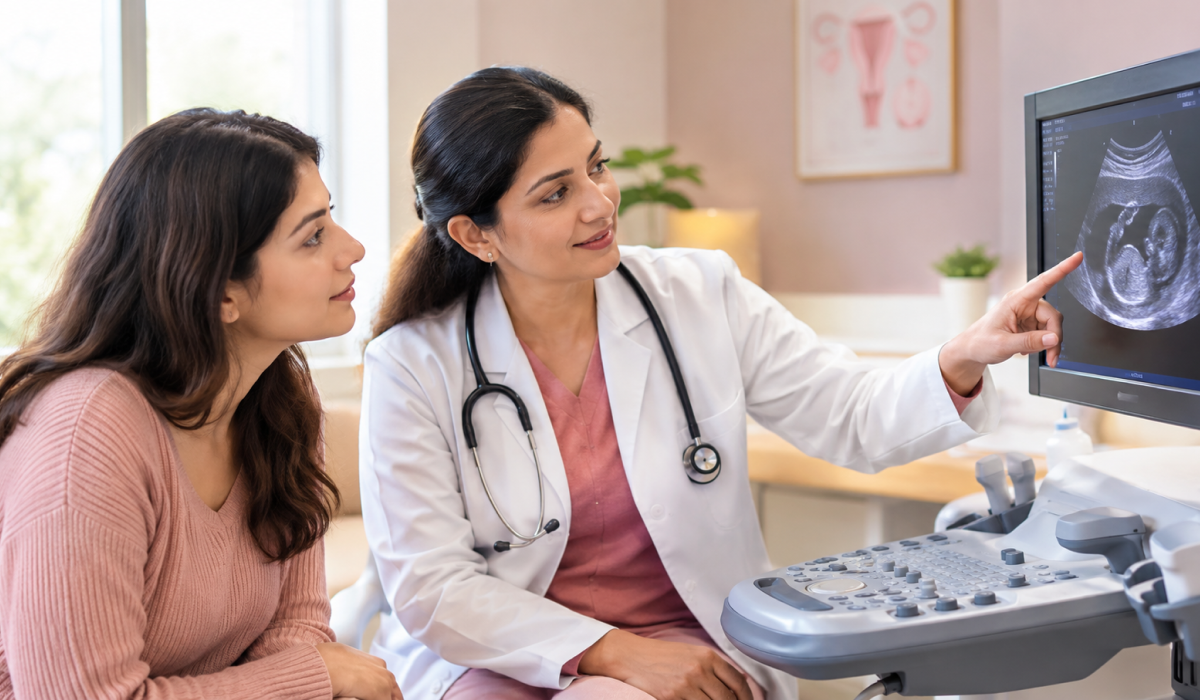
A transvaginal ultrasound gives your gynaecologist a direct look at your uterus and ovaries, and is one of the most informative tests in the entire workup.
It can reveal the number of developing follicles in each ovary, which helps assess ovarian reserve alongside the AMH test, the presence of ovarian cysts, including those associated with PCOS, uterine fibroids or polyps, which can affect implantation and often cause heavy periods as well, and the thickness and appearance of the uterine lining, which needs to reach a certain thickness to support a pregnancy.
This test is quick, painless for most women, and often done early in the workup since it provides so much useful information in a single visit.
Step 4: Checking the Fallopian Tubes (HSG Test)
A hysterosalpingogram, usually shortened to HSG, is an X-ray procedure that checks whether your fallopian tubes are open and whether the shape of your uterine cavity is normal.
A small amount of contrast dye is passed through the cervix into the uterus, and X-ray images track whether the dye flows freely through both fallopian tubes.
Blocked fallopian tubes, often resulting from a past pelvic infection or previous surgery, prevent the egg and sperm from meeting and are a significant, and very treatable once identified, cause of infertility.
The test is typically done in the first half of the menstrual cycle, after bleeding has stopped but before ovulation, and some women experience mild cramping during or shortly after the procedure.
Step 5: Laparoscopy, When Is It Needed?
Laparoscopy is a minor surgical procedure, done under anaesthesia, that allows your gynaecologist to directly visualize the pelvic organs through a small camera inserted via a tiny incision near the navel.
Unlike the earlier tests, this is not part of a routine initial workup, it is generally reserved for situations where endometriosis is suspected but not clearly visible on ultrasound, pelvic scarring or adhesions from previous surgery or infection are a concern, or earlier tests have not provided a clear explanation for ongoing difficulty conceiving.
The advantage of laparoscopy is that it is both diagnostic and, in many cases, therapeutic, meaning your gynaecologist can often treat certain issues, like removing endometriosis tissue or clearing mild scarring, during the very same procedure.
Testing for Male Infertility Alongside Female Testing
It is worth repeating something that gets overlooked far too often, a complete fertility evaluation is not a solely female process. A semen analysis, a simple, non-invasive test for your partner, is typically recommended early in the workup, often alongside your initial blood tests, rather than only after female testing comes back inconclusive.
Since male factors contribute to a substantial proportion of infertility cases, either alone or combined with female factors, testing both partners from the start saves considerable time and avoids one partner carrying the full weight of a diagnosis that may not even be fully explained by female factors alone.
How Long Does the Full Fertility Workup Take?
This varies depending on your specific situation, but a reasonable general timeline looks like this. Initial blood tests and consultation typically happen within the first two to four weeks. Ovulation tracking usually requires observing at least one full cycle, sometimes two, to establish a clear pattern.
A pelvic ultrasound is generally done within the first month, often at the same visit as your initial consultation. An HSG test needs to be timed to a specific point in your cycle, which can add a few weeks depending on when in your cycle you started the process.
For many women, a reasonably complete initial workup, excluding laparoscopy, is finished within one to two menstrual cycles, roughly four to eight weeks, though this can extend if certain tests need to be repeated or timed more precisely.
Understanding Your Results: What Happens Next
Once testing is complete, your gynaecologist will walk you through what the results actually mean and what they suggest about the most likely cause, or causes, behind your fertility difficulty.
In many cases, a clear, treatable cause is identified, an ovulation disorder, a thyroid imbalance, a blocked tube, or endometriosis, each of which has a well-established treatment pathway. Once treatment leads to a positive pregnancy, following a well-planned Indian diet trimester by trimester becomes just as important for a healthy outcome.
In some cases, all tests come back within normal ranges, a situation referred to as unexplained infertility. This can feel frustrating, since it does not offer a clean answer, but it does not mean nothing can be done.
Treatment options like ovulation induction, intrauterine insemination, or IVF are often still very effective even without a single identified cause, and your gynaecologist can guide you through which option makes sense based on your specific circumstances, age, and how long you have been trying to conceive.
Frequently Asked Questions
Q1: Do all these tests happen in a single visit?
No, testing is typically spread across one to two menstrual cycles, since certain tests, like ovulation tracking and the HSG, need to be timed to specific points in your cycle to give accurate results. Your gynaecologist will map out a testing schedule suited to your specific cycle.
Q2: Is fertility testing painful?
Most tests, including blood work and ultrasound, are painless or cause only mild, brief discomfort. The HSG test can cause temporary cramping during or shortly after the procedure, and laparoscopy, being a surgical procedure, involves standard post-surgical recovery, though it is minimally invasive with a relatively quick recovery time.
Q3: Do I need all of these tests, or does it depend on my situation?
It depends entirely on your situation. Many women do not need every test listed here, your gynaecologist will tailor the workup based on your history, symptoms, and initial results, only moving to more involved testing like laparoscopy when earlier tests do not provide a clear enough answer.
Q4: What if my test results come back completely normal?
Normal results across the board point toward unexplained infertility, which is more common than many people realize. It does not mean nothing can be done, treatment options like ovulation induction, IUI, or IVF are often successful even without a single identified cause.
Q5: Should my partner be tested at the same time as me, or only if my tests are inconclusive?
Ideally at the same time. A semen analysis is simple and non-invasive, and testing both partners from the start gives a complete picture faster, rather than assuming the cause must be female related and only checking male fertility later.
Book Your Fertility Evaluation in Mohali
Understanding exactly what a fertility workup involves can turn a source of anxiety into a clear, manageable process with a defined path forward.
Whether you are just starting to explore PCOS related concerns, want a complete evaluation before beginning treatment, or have already been trying for a while without answers, a structured diagnostic approach is the first real step toward clarity.
Schedule a consultation with Dr. Harpreet Kaur, Gynaecologist and Obstetrician in Mohali, to begin a thorough fertility evaluation and get the answers you have been waiting for.
Disclaimer: This blog is intended for general informational and educational purposes only and should not be considered a substitute for professional medical advice, diagnosis, or treatment. Fertility testing and its results vary from person to person. Always consult a qualified gynaecologist or fertility specialist for evaluation and guidance suited to your individual situation.